Saturday, February 03, 2007

Apropos


"I do not feel obliged to believe that the same god who has endowed us with sense, reason and intellect has intended us to forgo their use."

--Galileo de Galilei


"Victorious warriors win first and then go to war, while defeated warriors go to war and then seek to win."

--Sun-Tzu


"As you know, you have to go to war with the Army you have, not the Army you want."

--Donald Rumsfeld

Thursday, February 01, 2007

Life Ain't Fair


Why couldn't this bitch get cancer and die instead of Molly Ivins?

Thursday, January 18, 2007

Snowball & Napoleon Assume Command


In George Orwell’s famous novel, Animal Farm, the pigs controlling the revolution amend their makeshift constitution to read, “All animals are created equal, but some are more equal than others.” A similar kind of chicanery is taking place at some supposedly liberal blogs, where the motto seems to be, “All censorship is evil, but some forms of censorship are more evil than others,” ironically mimicking Orwell’s penetrating assessment of human nature.

I am speaking, of course, of the practice adopted by some otherwise admirable bloggers— Daily Kos and Crooks & Liars, to name a couple—to immediately delete any comment that mentions an alternative to the official account of the September 11th attacks. I’m not sure what the policy is at FireDogLake or Blue Gal or OneGoodMove, but this practice of stifling open debate seems antithetical to everything the blogosphere professes to stand for.

I understand that there are valid reasons for steering clear of the topic. Three thousand or so families lost someone that day, and they may not be ready to entertain the possibility of anything but the official version, and maybe some bloggers are trying to be sensitive to that fact. Or maybe they’re simply trying to prevent heated arguments in an otherwise peaceable (for the most part) atmosphere. Or perhaps they are worried about losing control of the blog, that every comment thread will be consumed by the topic.

Valid concerns, all.

But I suspect the real reason is that they’re afraid. They’re afraid that any open discussion on the topic will invite accusations of tinfoil hat-ism, thereby casting a dismissive pall over the rest of the blog. Perhaps they’re even afraid of unwanted attention from the perpetrators of 9/11. But most of all, they’re afraid of losing wanted attention from advertisers and prominent Democrats. Look how quickly Markos rolled over when he was criticized for his accurate observation that the Blackwater employees killed in Falluja were nothing but war profiteers. “I feel nothing over the death of mercenaries,” he wrote. “Screw them.” And he was right. Screw them. But screw Markos, too, for placing advertising dollars and mainstream acceptance above the truth.

The fact of the matter is that people trust C&L and Daily Kos; they feel they can get some straight dope that isn’t available on many of the sites that do cover alternative 9/11 theories. James Fetzer, Alex Jones and others in the 9/11-conspiracy camp have too many axes to grind, go off on too many tangents, employ too much sensationalism. It’s difficult for most rational people to cite them as credible sources. People therefore turn to C&L, et al. for confirmation. “Have you heard about this?” they wonder. “What’s your take?” Nothing. Nada. Zilch. Wind whistles, crickets chirp. But the deafening silence speaks volumes.


In the 1981 punk documentary, The Decline of Western Civilization, one mohawked participant explains the emergence of New Wave by saying, “If you call yourself ‘punk’ they won’t let you into the party and you won’t get any more coke.” Could that be what some lefty bloggers fear too?

Tuesday, November 07, 2006

Freedom of Choice is What You've Got

Saturday, November 04, 2006

Tuesday or Bust


The Midterm Election is on Tuesday, and, man, I cannot wait. I am so fucking sick of all this shit, I can’t even tell you. I guess I make a pretty poor political junkie, because I should be overdosing right now, and instead I can hardly even look at the crap.

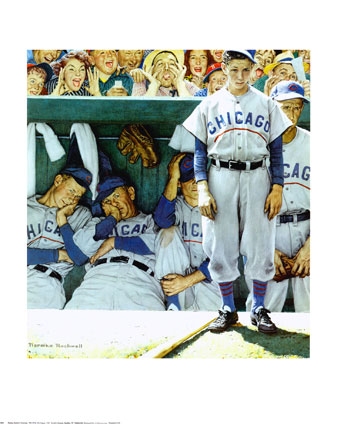
Being a liberal political junkie is sort of like being a Cubs fan. Every once in awhile, they manage to put together a winning team and make it into the post season, but Don Kessinger always always always drops a routine fly allowing the Mets to score three runs in the top of the ninth in game seven, if you know what I mean, and I think you do.

Well, somehow, the Cubs have made into the playoffs again, and the BIG GAME is on Tuesday. The fans are gripping the arms of their chairs waiting for the inevitable Steve Bartman to appear and fuck everything up. The suspense wears me out. I just want to go to bed and try not to think about it and wait until morning to find out what happened. But the suspense never ends. Even if John Kerry doesn’t throw over the first baseman’s head and we make it past the finals, we still have to play in the World Series. It’s too aggravating. I want to return to the comfort of ‘wait-till-next-year.’

But I can’t.

It’s like a car wreck — despite the repugnance of it all, I just can’t turn away. But that’s another metaphor. See what I mean? I can’t even face the thing directly. I need all these fucking metaphors just to discuss it. What hell.

Well, the Cubs have signed Lou Piniella as manager, and rumors are flying that A-Rod might also join the squad. In any event, Cubs General Manager, Jim Hendry has vowed to spend the necessary money to put together a winning team, so the future looks bright for the Cubs once again.

But for the Democrats, the future is now. But instead of playing to win, I fear they are playing to not lose, and that makes me sick with that familiar apprehension. It also makes me wonder why I even follow this sport. I mean, they’re just a bunch of whiny millionaires.

Saturday, October 28, 2006

Asylum Street Spankers


H/T: Norm

Saturday, October 21, 2006

This Explains A Lot


As some BDM readers may know, one of my favorite quotations is Bertrand Russell's observation that, "The problem with the world is that the stupid are cocksure and the intelligent are full of doubt." Now, thanks to a Cornell University study, this witty aphorism is supported with evidence. Read on:


Incompetence is bliss, say researchers
BY ERICA GOODE New York Times


There are many incompetent people in the world. But a Cornell University study has shown that most incompetent people do not know that they are incompetent.


People who do things badly, according to David A. Dunning, a professor of psychology at Cornell, are usually supremely confident of their abilities -- more confident, in fact, than people who do things well.


One reason that the ignorant also tend to be the blissfully self-assured, the researchers believe, is that the skills required for competence often are the same skills necessary to recognize competence.


The incompetent, therefore, suffer doubly, the researchers -- Dunning and Justin Kruger, then a graduate student -- suggested in a paper appearing in the December issue of the Journal of Personality and Social Psychology.


"Not only do they reach erroneous conclusions and make unfortunate choices, but their incompetence robs them of the ability to realize it," wrote Kruger, now an assistant professor at the University of Illinois, and Dunning.


This deficiency in "self-monitoring skills," the researchers said, helps explain the tendency of the humor-impaired to persist in telling jokes that are not funny, of day traders to repeatedly jump into the market -- and repeatedly lose out -- and of the politically clueless to continue holding forth at dinner parties on the fine points of campaign strategy.


Some college students, Dunning said, evince a similar blindness: After doing badly on a test, they spend hours in his office, explaining why the answers he suggests for the test questions are wrong.


In a series of studies, Kruger and Dunning tested their theory of incompetence. They found that subjects who scored in the lowest quartile on tests of logic, English grammar and humor were also the most likely to "grossly overestimate" how well they had performed.


In all three tests, subjects' ratings of their ability were positively linked to their actual scores. But the lowest-ranked participants showed much greater distortions in their self-estimates.


Aiming high -- real high
Asked to evaluate their performance on the test of logical reasoning, for example, subjects who scored in only the 12th percentile guessed that they had scored in the 62nd percentile and deemed their overall skill at logical reasoning to be at the 68th percentile.


Similarly, subjects who scored at the 10th percentile on the grammar test ranked themselves at the 67th percentile in the ability to "identify grammatically correct standard English" and estimated their test scores to be at the 61st percentile.


On the humor test, in which participants were asked to rate jokes according to their funniness (subjects' ratings were matched against those of an "expert" panel of professional comedians), low-scoring subjects were also more apt to have an inflated perception of their skill. But because humor is idiosyncratically defined, the researchers said, the results were less conclusive.


Unlike their unskilled counterparts, the most able subjects in the study, Kruger and Dunning found, were likely to underestimate their own competence. The researchers attributed this to the fact that, in the absence of information about how others were doing, highly competent subjects assumed that others were performing as well as they were -- a phenomenon psychologists term the "false consensus effect."


When high-scoring subjects were asked to "grade" the grammar tests of their peers, however, they quickly revised their evaluations of their own performance. In contrast, the self-assessments of those who scored badly themselves were unaffected by the experience of grading others; some subjects even further inflated their estimates of their own abilities.


"Incompetent individuals were less able to recognize competence in others," the researchers concluded.


In a final experiment, Dunning and Kruger set out to discover if training would help modify the exaggerated self-perceptions of incapable subjects. In fact, a short training session in logical reasoning did improve the ability of low-scoring subjects to assess their performance realistically, they found.


The findings, the psychologists said, support Thomas Jefferson's assertion that "he who knows best knows how little he knows."


Such studies are not without critics. David C. Funder, a psychology professor at the University of California-Riverside, for example, said he suspected that most lay people had only a vague idea of the meaning of "average" in statistical terms.


But Dunning said his current research and past studies indicated that there were many reasons why people would tend to overestimate their competency and not be aware of it.


Concrete clues
In some cases, Dunning pointed out, an awareness of one's own inability is inevitable: "In a golf game, when your ball is heading into the woods, you know you're incompetent," he said.


But in other situations, feedback is absent, or at least more ambiguous; even a humorless joke, for example, is likely to be met with polite laughter. And social norms prevent most people, when faced with incompetence, from blurting out, "You stink!" -- truthful though this assessment may be.

Wednesday, October 18, 2006

One that Should've Been in my Top 5

My Five Favorite Rap Songs


Last week, Howie held a contest over at C&L asking readers to name their five favorite rap songs and why. He selected five winners from over 300 entries and I was one. Yay! In case you're wondering, here's my entry:

“Tread Water,” by De La Soul, from the album 3 Feet High and Rising, was the first rap song to convince me that rap and hip hop were valid, versatile musical forms and not just clever novelties. The song uses the theme of treading water as a metaphor for surviving the hassles of daily urban life from the middle class black perspective, providing a welcome departure from the tales of street life that dominate the genre. The Motown groove and pioneering use of samples presage the emergence of such later electronic artists as Thievery Corporation and Herbaliser. De La Soul’s inventive blend of pop culture sound bites, country, pop and rock grooves, and we’re-all-in-it-together attitude changed a lot of people’s minds about what rap could accomplish.

“The Day the Niggaz Took Over/Nuthin’ but a “G” Thang”, by Dr. Dre, combined the party attitude of old-school rap with a hybrid of 60s black radicalism and insouciant criminal behavior. The opening track of this two-track medley from the multi-platinum album, The Chronic, fantasizes about opposing street gangs uniting to overthrow corrupt, white-owned society. The song opens with what sounds like a field recording of a black activist yelling to a crowd, “If you ain’t down for the Africans here in the United States, period point blank; if you ain’t down for the ones that suffered in South Africa from apartheid and shit, Devil you need to step your punk ass to the side and let us brothers, and us Africans, step in and start puttin’ some foot in that ass!” Heh heh. That rather sets the tone for the remainder of the song, which pretty much calls for a long overdue armed revolution. A chorus of apparently enraged men chants, “Break ’em off something. Break ’em off something,” as various rappers take turns describing their roles and their motives, culminating in Dre’s explanation: “Sittin’ in my living room, calm and collected/ Feelin’ that I gotta get my perspective/’cause what I just heard, broke me in half…” Later, he describes what he has in mind: “Bloods, Crips on the same squad/With the Eses’ help, nigga, it's time to rob and mob.” The insistent beat — reminiscent of the final scene of Sam Peckinpah’s legendary film The Wild Bunch — increases the song’s militant demeanor, and painfully illustrates how little progress we’ve made since CSN&Y sang, “Gotta get down to it/Soldiers are gunning us down/Shoulda been done long ago.” The song is interspersed with clips of news reports depicting widespread looting in Los Angeles, and the sounds of helicopters fading in and out. The song climaxes with Dre shouting, “Helicopters flyin’/these motherfuckers tryin’/to catch me and stretch me on Death Row/But hell no, suppose black refuse to go?” Moments later, rage and revolution blend into the stoned chill-out of “Nuthin’ but a “G” Thang,” with its Parliament groove and Snoop Doggy Dogg’s blithe delivery. Combined, these two songs revealed to the nation what black America was up against better than any academic treatise or militant manifesto ever could.

“She Watch Channel Zero,” by Public Enemy tells the tale of a woman who forsakes cultural awareness in exchange for television addiction. As Flava Flav says at the song’s opening, “You’re blind, baby. You’re blind from the facts of who you are ‘cause you’re watching that garbage.” The song appears on It Takes a Nation of Millions to Hold Us Back, one of the most revolutionary albums in all of music. Like De La Soul, Public Enemy influenced a generation of knob twiddlers with their limitless barrage of heavy metal riffs, hard funk beats and wildly divergent musical samples. The album’s lyrical themes mark an arrival for black music in that they directly confront the racial and social inequities that define modern urban America, unlike earlier black musicians who only hinted at such themes. This profoundly influenced such later rappers as Ice-T and N.W.A. This song has particular appeal to me because I share the song’s assertion that most television programming is pure garbage, and that TV is the main culprit behind America’s cultural ignorance and political naiveté.


Straight Up Nigga,” by Ice-T, from the album Original Gangster is probably my favorite rap song. The song’s narrator skillfully blends the righteous indignation undoubtedly felt by many urban blacks in the Rodney King era with a shrewd political awareness and sense of irony. “I’m a nigga in America, and that much I flaunt,” says the narrator, “’Cause when I see what I like, yo I take what I want/I’m not the only one, that’s why I’m not bitter, ’Cause everybody is a nigga to a nigga,” implying that the American Way is to steal or otherwise get away with as much as possible. He then uses American history to support his point by saying, “America was stole from the Indians, show and prove/What was that? A straight up nigga move/A low down shame, yo it’s straight insane/Yet they complain when a nigga snatch their gold chain/What the hell is a nigga supposed to do? Wait around for a handout from a nigga like you?” The song also manages to depart from the homophobia sadly common to much rap by saying, “She wanna be les, he wanna be gay/Well I’m straight, so nigga have it your way.”The song is accompanied by Evil E’s funk groove that both shuffles and slams, providing perfect punctuation for the lyrics.

Friday, October 13, 2006

What If?

The London Times online has published this graphic explanation of how long it would take Earth to recover from human occupation.